Multidimensional Computer Adaptive Testing (MCAT): Procedure and Process
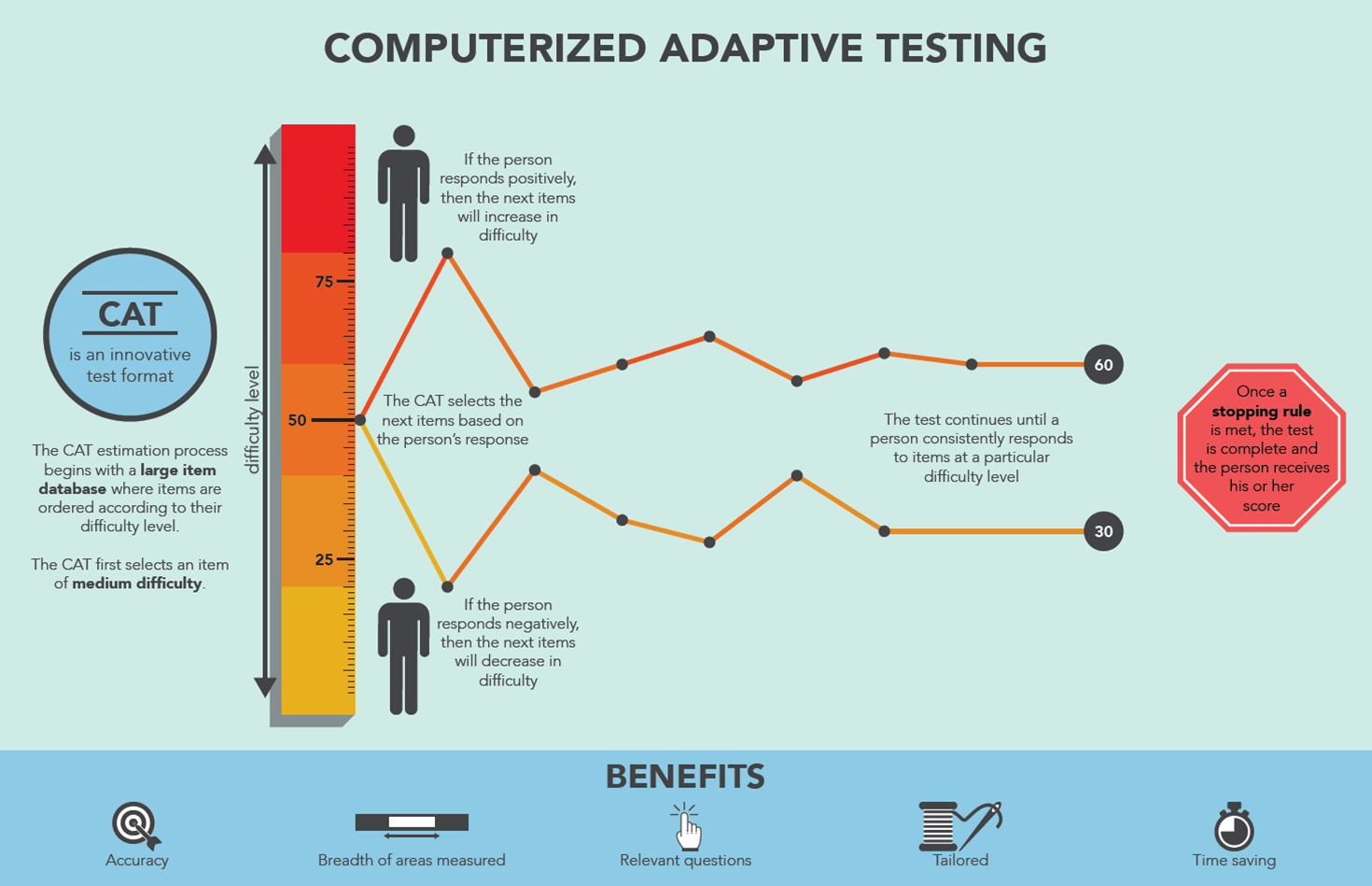
Thumbnail Credit
Abstract: Multidimensional Computer Adaptive Testing (MCAT) extends the classical unidimensional CAT framework to simultaneously estimate multiple latent traits. This document details the theoretical foundations, algorithmic procedures, item selection strategies, ability estimation methods, and stopping rules that govern the MCAT process, with reference to seminal and contemporary literature.
1. Theoretical Background
Multidimensional Computer Adaptive Testing (MCAT) is a psychometric framework that generalizes unidimensional CAT (UCAT) to settings where examinees possess a vector of latent traits rather than a single ability [1][2]. The fundamental motivation is that most cognitive, psychological, and educational constructs are inherently multifaceted; a single scalar cannot adequately characterize proficiency in, for example, mathematics (algebra, geometry, statistics) or language ability (reading, grammar, vocabulary) [3].
MCAT was formalized extensively by Reckase [4] through the development of Multidimensional Item Response Theory (MIRT), which provides the probabilistic measurement model underlying all MCAT procedures. The adaptive component ensures that items administered to an examinee are optimally informative given the current estimate of the ability vector [1][5].
2. Item Response Theory in Multiple Dimensions
2.1 The Latent Trait Vector
In MCAT, each examinee is characterized by a -dimensional ability vector:
Variable Notes:
| Symbol | Description |
|---|---|
| Latent trait (ability) vector | |
| Latent ability on dimension | |
| Total number of dimensions (latent traits) |
2.2 Multidimensional Item Response Model
The most widely used model in MCAT is the Multidimensional Two-Parameter Logistic (M2PL) model [4][6]:
Variable Notes:
| Symbol | Description |
|---|---|
| Binary response of examinee to item (1 = correct, 0 = incorrect) | |
| Ability vector of examinee | |
| Discrimination parameter vector for item on each dimension | |
| Scalar intercept (difficulty) parameter for item | |
| Dot product: |
For the Multidimensional Three-Parameter Logistic (M3PL) model with guessing [4][7]:
Variable Notes:
| Symbol | Description |
|---|---|
| Pseudo-guessing parameter for item () |
2.3 Item Information in Multiple Dimensions
The Fisher Information Matrix (FIM) for item given ability is a matrix [1][8]:
where:
Variable Notes:
| Symbol | Description |
|---|---|
| Fisher Information Matrix for item | |
| Probability of correct response to item | |
| Probability of incorrect response | |
| Derivative of with respect to the linear predictor | |
| Outer product of the discrimination vector (rank-1 matrix) |
The cumulative FIM after administering items is:
3. The MCAT Process Overview
The following diagram illustrates the complete MCAT procedure from initialization to termination:
4. Step-by-Step Procedure
Step 1: Initialization
Before any item is administered, the system establishes:
- Prior ability distribution: , typically , (identity matrix) [2][9]
- Item bank: A calibrated pool of items with known MIRT parameters
- Starting ability estimate:
Step 2: Item Selection
At step , the item is selected from the remaining bank using a selection criterion :
Common criteria are detailed in Section 6.
Step 3: Item Administration
Item is presented to the examinee who provides response (for dichotomous items) or (polytomous items).
Step 4: Ability Re-estimation
The ability vector is updated using accumulated response vector .
Log-likelihood function [1][6]:
Details of estimation methods are in Section 5.
Step 5: Update Information Matrix
Step 6: Check Stopping Rule
Evaluate whether stopping criteria are satisfied (see Section 7). If yes → proceed to scoring; if no → return to Step 2.
Step 7: Score Reporting
Provide the final estimate along with the standard error vector:
Variable Notes:
| Symbol | Description |
|---|---|
| Vector of standard errors for each dimension estimate | |
| Diagonal extraction operator | |
| Inverse of the cumulative FIM (posterior covariance approximation) |
5. Ability Estimation Methods
5.1 Maximum Likelihood Estimation (MLE)
MLE finds by maximizing the log-likelihood [1][10]:
The score function (gradient):
Solved via Newton-Raphson iteration [10]:
Variable Notes:
| Symbol | Description |
|---|---|
| Iteration index in Newton-Raphson | |
| Score function (gradient of log-likelihood) |
⚠️ Limitation: MLE is undefined when all responses are correct or all incorrect (degenerate response patterns) [2].
5.2 Maximum A Posteriori (MAP) Estimation
MAP incorporates a prior distribution (typically multivariate normal) [2][9]:
With a multivariate normal prior :
The modified Newton-Raphson step becomes:
Variable Notes:
| Symbol | Description |
|---|---|
| Prior density of ability vector | |
| Prior mean vector (often ) | |
| Prior covariance matrix | |
| Precision matrix of the prior |
5.3 Expected A Posteriori (EAP) Estimation
EAP computes the posterior mean [9][11]:
where the likelihood:
In practice, EAP is computed via Gauss-Hermite quadrature or Monte Carlo integration over a grid of quadrature points [9]:
Variable Notes:
| Symbol | Description |
|---|---|
| -th quadrature point in the -dimensional grid | |
| Quadrature weight for point | |
| Likelihood of observed responses given |
6. Item Selection Criteria
6.1 Maximum Determinant (D-optimality)
Select the item that maximizes the determinant of the updated FIM [1][8][12]:
Interpretation: Maximizes the volume of the confidence ellipsoid's reciprocal — reduces overall estimation uncertainty across all dimensions simultaneously.
6.2 Minimum Trace of Posterior Covariance (T-optimality / A-optimality)
Interpretation: Minimizes the sum of posterior variances across all dimensions [5][13].
Variable Notes:
| Symbol | Description |
|---|---|
| Matrix trace operator (sum of diagonal elements) | |
| Matrix determinant |
6.3 Kullback-Leibler Information (KL-criterion)
Maximizes the expected Kullback-Leibler divergence between item response distributions at the current estimate and neighboring ability values [14]:
Variable Notes:
| Symbol | Description |
|---|---|
| Neighborhood region around | |
| KL information for item at current ability estimate |
6.4 Mutual Information Criterion
Selects items that maximize the mutual information between the item response and the ability vector [15]:
Summary Comparison
7. Stopping Rules
7.1 Fixed Test Length
The simplest rule: terminate after exactly items [1]:
7.2 Standard Error Threshold
Terminate when the standard error for all dimensions falls below a threshold [2][5]:
Or alternatively for the joint criterion using the posterior covariance matrix:
Variable Notes:
| Symbol | Description |
|---|---|
| Standard error threshold (e.g., 0.30 on the logit scale) | |
| Joint variance threshold for all dimensions |
7.3 Change in Ability Estimate
Terminate when successive ability estimates converge [16]:
Variable Notes:
| Symbol | Description |
|---|---|
| Euclidean (L2) norm | |
| Convergence threshold (e.g., 0.01) |
7.4 Minimum-Maximum Length Rule (Hybrid)
Combines fixed and SE-based rules for practical testing [2][5]:
8. Item Exposure Control
Uncontrolled item selection leads to overexposure of highly informative items, compromising item security. Several methods address this [17][18]:
8.1 Sympson-Hetter Method (Randomization)
Each item is selected with probability , where is tuned so that the exposure rate [17]:
Variable Notes:
| Symbol | Description |
|---|---|
| Observed exposure rate of item | |
| Maximum allowable exposure rate (e.g., 0.20) | |
| Unconditional selection probability of item | |
| Randomization parameter for item |
8.2 Maximum Priority Index (MPI)
Uses a priority index combining information and exposure [18]:
Variable Notes:
| Symbol | Description |
|---|---|
| Weights balancing information gain vs. exposure penalization | |
| Item selection criterion value (e.g., determinant) |
9. Content Balancing
Real-world tests require that items cover specified content areas proportionally [19]. The constrained CAT problem is:
where is the set of items from content area that can still be administered to meet the target distribution [19][20].
The Shadow Test approach [20] solves a 0-1 integer programming problem at each step to select a full-length "shadow test" that satisfies all constraints, then administers only the optimal next item from it:
Variable Notes:
| Symbol | Description |
|---|---|
| Binary decision variable (1 if item included in shadow test) | |
| Required number of items from content area | |
| Target proportion for content area |
10. Comparison: Unidimensional vs. Multidimensional CAT
| Feature | Unidimensional CAT | Multidimensional CAT |
|---|---|---|
| Latent space | Scalar | Vector |
| Item information | Scalar | Matrix |
| Estimation | MLE/MAP (1D optimization) | MLE/MAP (K-D optimization) |
| Item selection | Maximize | Maximize of FIM |
| Stopping rule | ||
| Computational cost | Low | Higher (matrix operations) |
| Score report | Single score + SE | Score profile + SE vector |
| Between-dimension correlation | Not applicable | estimated |
References
[1] Segall, D. O. (1996). Multidimensional adaptive testing. Psychometrika, 61(2), 331–354.
[2] Reckase, M. D., & Segall, D. O. (2009). Multidimensional adaptive testing. In W. J. van der Linden & C. A. W. Glas (Eds.), Elements of Adaptive Testing (pp. 203–217). Springer.
[3] van der Linden, W. J., & Hambleton, R. K. (Eds.). (1997). Handbook of Modern Item Response Theory. Springer.
[4] Reckase, M. D. (2009). Multidimensional Item Response Theory. Springer.
[5] Mulder, J., & van der Linden, W. J. (2009). Multidimensional adaptive testing with Kullback-Leibler information item selection. In W. J. van der Linden & C. A. W. Glas (Eds.), Elements of Adaptive Testing (pp. 77–101). Springer.
[6] McKinley, R. L., & Reckase, M. D. (1983). An extension of the two-parameter logistic model to the multidimensional latent space. ETS Research Report. Educational Testing Service.
[7] Reckase, M. D. (1985). The difficulty of test items that measure more than one ability. Applied Psychological Measurement, 9(4), 401–412.
[8] Berger, M. P. F. (1992). Sequential sampling designs for the two-parameter item response theory model. Psychometrika, 57(4), 521–538.
[9] Bock, R. D., & Mislevy, R. J. (1982). Adaptive EAP estimation of ability in a microcomputer environment. Applied Psychological Measurement, 6(4), 431–444.
[10] Lord, F. M. (1980). Applications of Item Response Theory to Practical Testing Problems. Lawrence Erlbaum.
[11] Mislevy, R. J. (1986). Bayes modal estimation in item response models. Psychometrika, 51(2), 177–195.
[12] Silvey, S. D. (1980). Optimal Design. Chapman and Hall.
[13] van der Linden, W. J. (1999). Multidimensional adaptive testing with a minimum error-variance criterion. Journal of Educational and Behavioral Statistics, 24(4), 398–412.
[14] Chang, H.-H., & Ying, Z. (1996). A global information approach to computerized adaptive testing. Applied Psychological Measurement, 20(3), 213–229.
[15] Cover, T. M., & Thomas, J. A. (2006). Elements of Information Theory (2nd ed.). Wiley.
[16] Weiss, D. J. (1982). Improving measurement quality and efficiency with adaptive testing. Applied Psychological Measurement, 6(4), 473–492.
[17] Sympson, J. B., & Hetter, R. D. (1985). Controlling item-exposure rates in computerized adaptive testing. Proceedings of the 27th Annual Meeting of the Military Testing Association.
[18] Leung, C. K., Chang, H.-H., & Hau, K.-T. (2002). Item selection in computerized adaptive testing: Improving the a-stratified design with the Sympson-Hetter algorithm. Applied Psychological Measurement, 26(4), 376–392.
[19] Stocking, M. L., & Swanson, L. (1993). A method for severely constrained item selection in adaptive testing. Applied Psychological Measurement, 17(3), 277–292.
[20] van der Linden, W. J. (2005). Linear Models for Optimal Test Design. Springer.
Document prepared with reference to foundational MIRT and MCAT literature. All mathematical notation follows standard psychometric conventions. LaTeX formulas are rendered in Markdown-compatible environments (e.g., Obsidian, Jupyter, Pandoc with MathJax/KaTeX).